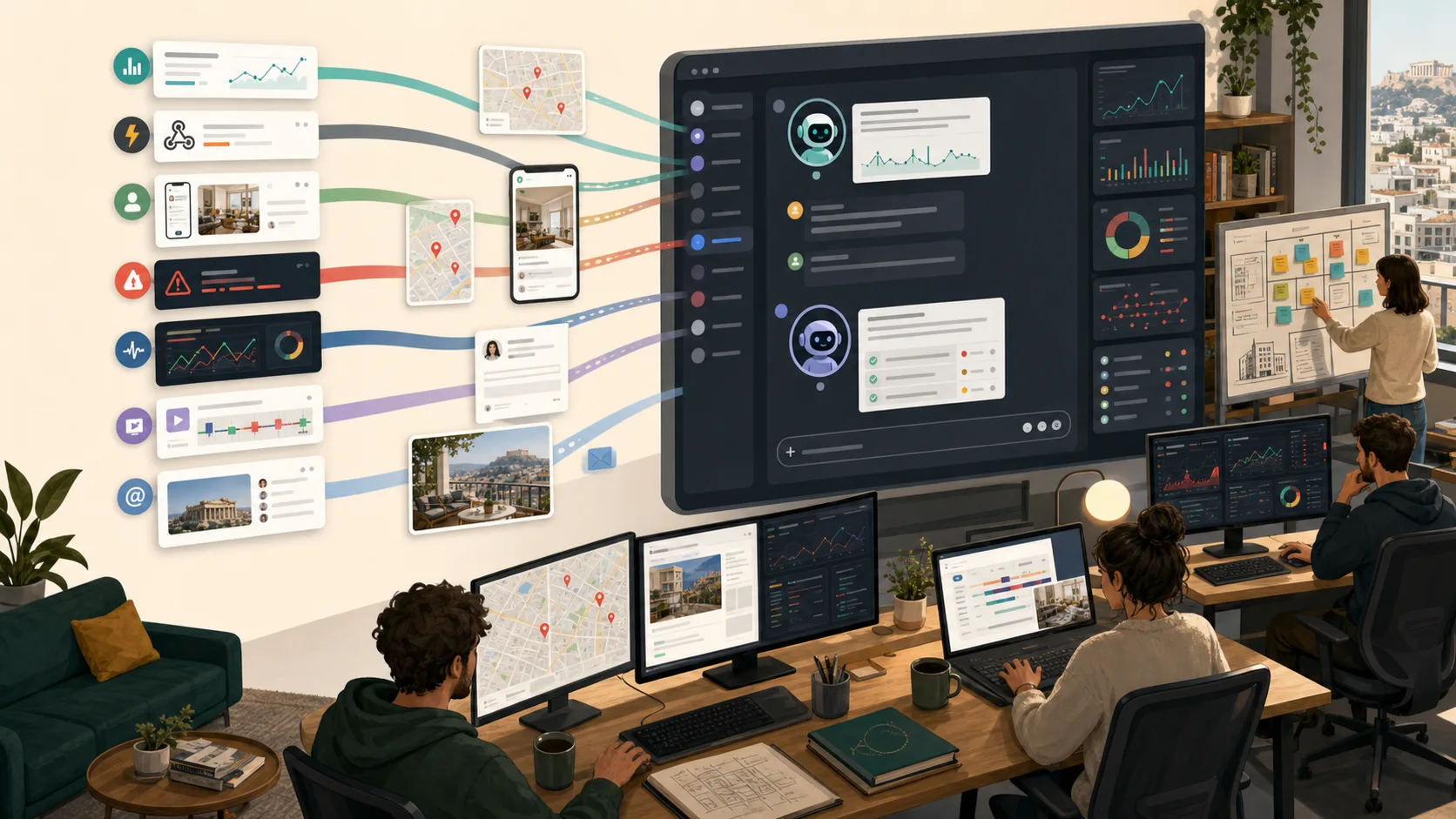
I recently helped a small team tidy up the ops around an early flat-sharing marketplace in Greece. The product already threw off useful signals every day. Traffic shifted, errors surfaced, pages slowed down, signups and contact messages came in and the product showed up in public conversations now and then.
The information all existed. It just lived in separate dashboards, each one needing its own visit before anything reached the team. When a small team is heads-down shipping, that visit is the first habit to slip.
So the brief was narrow. Get the signals that matter into the place where the team already works, let the agents handle the first read and leave the decisions with people.
The room
Everything runs on a Discord server that doubles as the ops room. I wired in two agents to see how each one behaves next to the team. One is Openclaw running ChatGPT 5.5. The other is Hermes running Opus 4.8 through Bedrock.
For this kind of work a shared channel beats a private model tab. Someone drops a thought, the agents answer from different angles and the rest of the team is right there to pile on a question, some context or an idea of its own. The thinking and the work end up in the same thread instead of scattered across private tabs.
The guardrails are the part I would actually defend. The agents summarize, compare, triage and draft. Production access stays with people. User messages stay with people. Public posts stay with people. The agents make the team faster at deciding. The decision stays with the team.
The channels
Each workflow gets its own channel so one stream never buries another. Here is the split we landed on.
The rhythm is the same across all of them. Scheduled jobs post the routine reports while webhooks carry whatever is live. Signup and contact events go into Leads. Sentry and Grafana go into Monitoring. An agent reads the noise in each channel before anyone else has to.
Reports and events
A scheduled job drops analytics summaries into Discord on a fixed rhythm, so the team reads the story in the channel instead of hunting for it.
Traffic up 18% on the period. Listing page got more visits but fewer contact clicks. Most of it mobile. Highest-exit page was onboarding.
The last line is where it earns its place. In a dashboard that fact can sit untouched for a week. In the channel it turns into a conversation about which page pulls traffic but loses people, which source actually converts and what to change first if the team wants more contact requests. The agent gathers the numbers and flags the odd one. A person reads the meaning into it.
Product events arrive as they happen and stay short. A signup event can show the source and what the user did before leaving. A contact event can show the listing page and the time from landing to submit. A single event is just noise, but twenty of them start to form a shape. The agent scans the batch for the thread running through them.
Monitoring
Scheduled Lighthouse runs watch the pages that matter. The raw output is too noisy for a team channel, so the agent boils it down to a short note with the suspect named.
Listing page slower on mobile. LCP moved from 2.4s to 3.6s. Likely the image payload.
A regression that would otherwise stay hidden gets surfaced before a user feels it.
Session review works the same way. Watching recordings at random burns time, so the agent thins the pile to the handful worth opening. A session that stalls halfway, or the same exit point hit again and again, is far easier to act on than a wall of recordings. The team watches ten useful sessions instead of skipping past hundreds.
Sentry and Grafana come in by webhook. The agent runs the first triage in the channel, explains the issue in plain words and points at the flow it touches and the changes that landed around it. It also hands the team a short checklist to start from. The fixing stays with the team and the first thirty seconds of it get a lot cleaner.
The data line
When an agent needs real data, it gets its own database user with read-only access to a single materialized view built for reporting. Identifying fields are stripped out and the production tables stay well out of reach.
That narrow view answers most of the product questions on its own. It shows recent signup patterns and the listing types people gravitate to. It also surfaces the points where they stall before finishing a flow. It can pull a few product hypotheses out of the last hundred events too. Enough context to be useful, with a blast radius you can see at a glance.
Outside the product
In a marketplace the demand often shows up outside the product before it shows up inside it. People ask in communities and complain about the tools they already use, often describing in plain words exactly what they wish those tools did. The setup filters those public signals into the Signals channel where a person decides whether any of it is worth acting on. Outreach stays human.
The social workflow has the same shape. The agent turns recurring questions into post ideas and reshapes a product update into a LinkedIn draft. It will propose an image concept and rough out next week's calendar too. A person edits and publishes from there.
What changed
The individual pieces are simple. A few scheduled summaries, a couple of webhooks, first-pass agent triage and one tight read-only view. What actually made the difference was putting all of it where the team already spends its day.
The team now spends less of its attention checking and more of it deciding. For a small group, that is most of the win.
What automations have you set up for your own team?